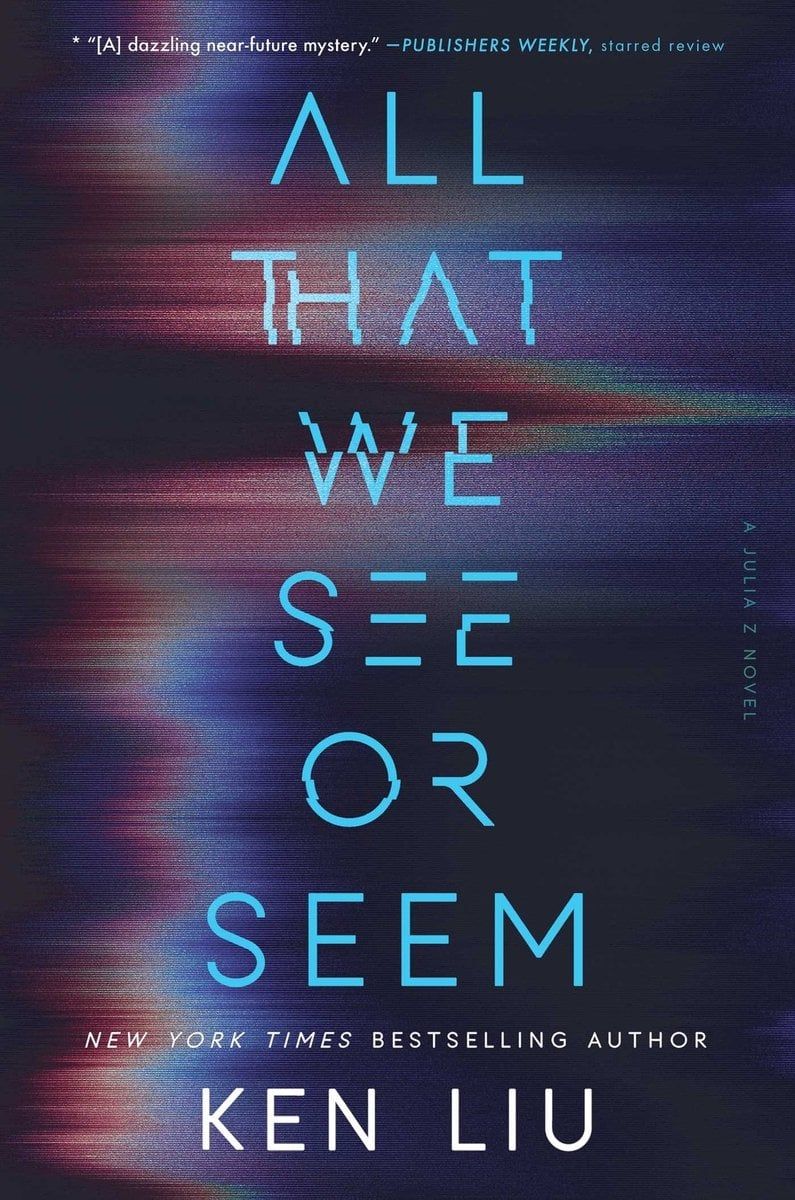
There is a certain trope of sci-fi novels that never ceases to hook me into a book, and that's the one with lots of very odd and exotic proper nouns. The novel All That We See or Seem by Ken Liu had so many of them in the first few pages—cephaloscripts, neuromesh, egolets, just to name a few—that I had a pretty good idea that I was going to enjoy this novel.
In this book we follow Julia Z, who is a very experienced hacker in near-future Boston. She is approached by Piers Neri, who is looking for help finding his missing wife, Elli, who he, at least initially, believes has been kidnapped. His wife is a moderately famous oneirofex, another amazing proper noun by the way, which in the book universe is a person who facilitates group dream sessions that are mediated and augmented by personal AIs. Julia declines to help Piers initially, but her own AI, named Talos, lets her know that she might be in danger due to the group of henchmen that tracked Piers to her place. Julia then engages in some great spycraft to leave her apt undetected and eventually meet up with Piers to help him in his search. From there we learn a lot more about the fascinating world of the vivid dreamers that Elli was a part of and try to figure out where she might be.
Beyond just really enjoying the near-future world building that Liu accomplishes, I really enjoyed the story as well. From the first page of the book, the reader is aware that Elli hasn't been kidnapped and instead went on the run for her own purposes, so it's interesting to see how the characters eventually come to terms with that reality and how it impacts them. I think Liu also made a few bold choices. While I wouldn't call it a twist, around sixty percent of the way through the book there is a big plot turn that I wasn't expecting from this kind of book.
We also learn a lot about the backstory of Julia Z, and she herself is a very interesting character. Daughter of an immigrant whose mother became a very vocal and outspoken activist, which caused Julia to have a tumultuous childhood. She eventually ended up living on her own in a number of bad situations before getting involved with a radical hacking group, which is where she learned so much of her tradecraft. Beyond just being interesting background on her character for the book, I don't think it's too much of a spoiler due to the way Amazon even catalogs the book, but it seems like there will be future books with this protagonist as the lead.
If you are looking for a light techno-thriller set in a world that isn't too different from our own, I would highly recommend All That We See or Seem. Don't let all the neologisms scare you off from a well crafted and well told story. I’m looking forward to the next book in the series, which is currently scheduled for release in the Spring of 2027.