
Excession
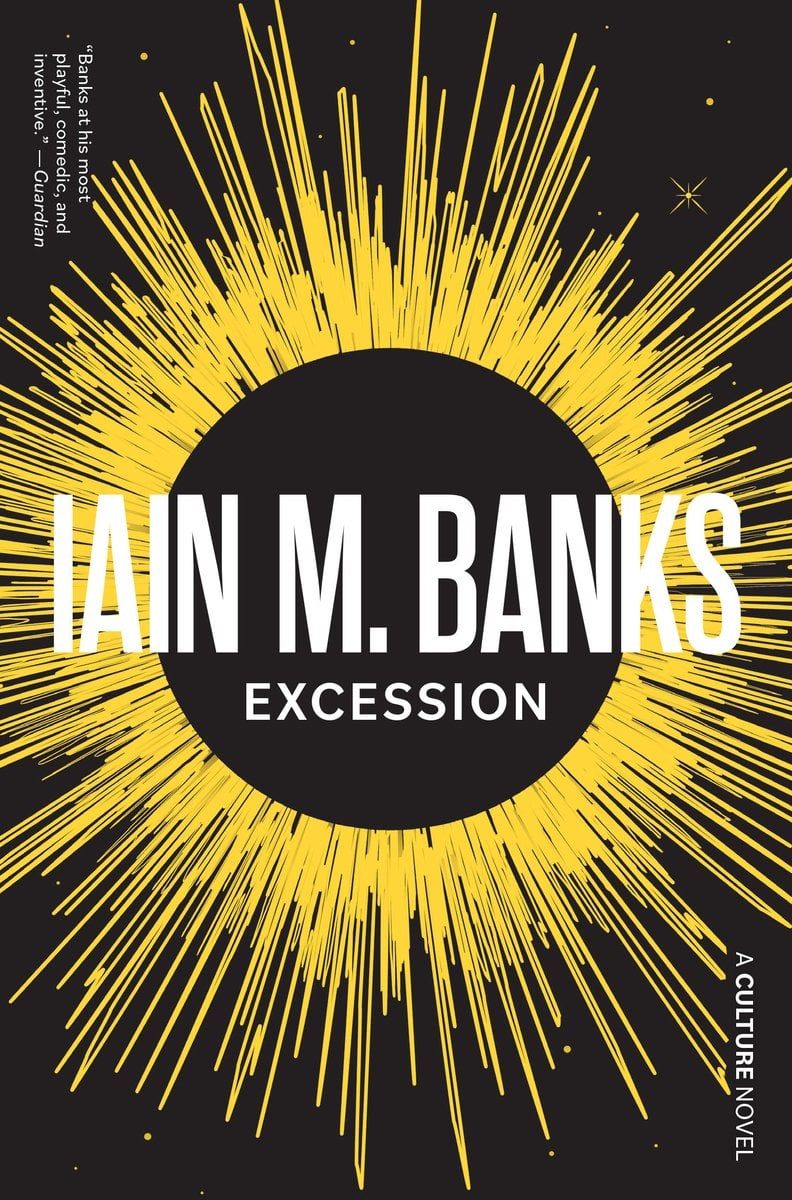
After the past few months of reading various long lists for the Booker and some other upcoming fiction prizes, which on the whole I haven't super enjoyed, I decided I needed to return to a type of fiction that never lets me down. I'm speaking, of course, of far-future space operas. The best author in that genre, in my opinion, is the criminally overlooked Peter F. Hamilton, but a close second is the sadly departed Iain M. Banks. When it comes to his sci-fi writing, he's best known for a series of ten books that all take place in a shared universe that mostly centers on a civilization named the Culture.
The civilization of the Culture seen in the books is one of the most utopian you'll find in mainstream fiction. Hundreds of billions of humans and other alien races live together in basically a post-scarcity world, spread across million-kilometer-long space habitats or enormous General Systems Vehicles that are over 200 kilometers long and can hold millions of souls on board. The ships themselves have randomly assorted names, like Sleeper Service, Just Read the Instructions, or Reasonable Excuse, and are controlled by incredibly sophisticated AIs of a type they call Minds.
Given the basis of the world being stable, peaceful and incredibly carefree, it shouldn't be too much of a surprise that most of the novels set in the Culture-verse look to external factors coming up against the Culture in order to drive the conflict needed for a satisfying novel. In this book of the Culture series, book five of ten, Excession, the external factor is the reappearance of what they term the Excession. It presents itself as a perfect black-body sphere exactly 53.34 kilometers in diameter, with zero apparent mass but directly connected to the underlying energies of the universe in ways that even the Culture can't achieve. This leads to a secret, self-organizing collection of ships, which call themselves the "Interesting Times Gang," attempting to control access to the artifact before anyone else can.
I am only slowly working my way through the ten books of the Culture series, but Excession has by far been my favorite that I've read thus far. While in my literary fiction I enjoy strong characterization and deep emotions, when it comes to my space operas, I like super-advanced technology, descriptions of cool spaceships and universe-spanning mysteries. Let me tell you, this book has all of those in spades. My only criticism of it is that, ironically, there is far too little of the actual Excession featured in the story. It is very much used as a MacGuffin to start and propel all the main actors along in their arcs, but I do wish we could have gotten more scenes and even point of view from it. Some minor spoilers for the end: what is revealed only to the readers, and not actually to anyone in the story, is that the Excession was there to do a bit of recon to see the state of the life around the area it popped into. Due to the events in the book, though, the local volume of the Milky Way doesn't exactly cover itself in glory, and the object decides to leave with all of its far-future secrets intact.
While I love the sort of rarefied techno-speak that only the true greats of sci-fi can spout (true fans know the wonder of monobonded concrete), I would caution people if they choose this as their first novel of the Culture. While none of them are direct sequels or continuations of each other, it doesn't hurt to have a passing familiarity with the universe and concepts. All in all, if you are a hard sci-fi/space opera fan and you haven't checked out the series, you thankfully have a big backlog to look forward to.
This review contains affiliate links. If you buy through one I earn a small commission, at no extra cost to you.
- ← Previous
Unfinished Harauld Hughes