
If We Cannot Go at the Speed of Light
Even though we are still a few weeks away from the crowning of the 2026 Booker Prize winner, time keeps marching onward. Thanks to a recent TikTok, I discovered that the list of books that are eligible for consideration for the 2027 international version of the prize has been compiled by an industrious book influencer, which I’ll link here. In 2027 the award will actually be renamed the Bukhman International Booker Prize. The influencer is going to make an effort to catalog their reading of most or all of the possible books. I absolutely am not committing to anything like that, but it will be interesting to see how many of them entice me to try them out between now and next year. In going through the list I did realize that I had already read one of the eligible books, so consider this your first Booker Prize 2027 related review!
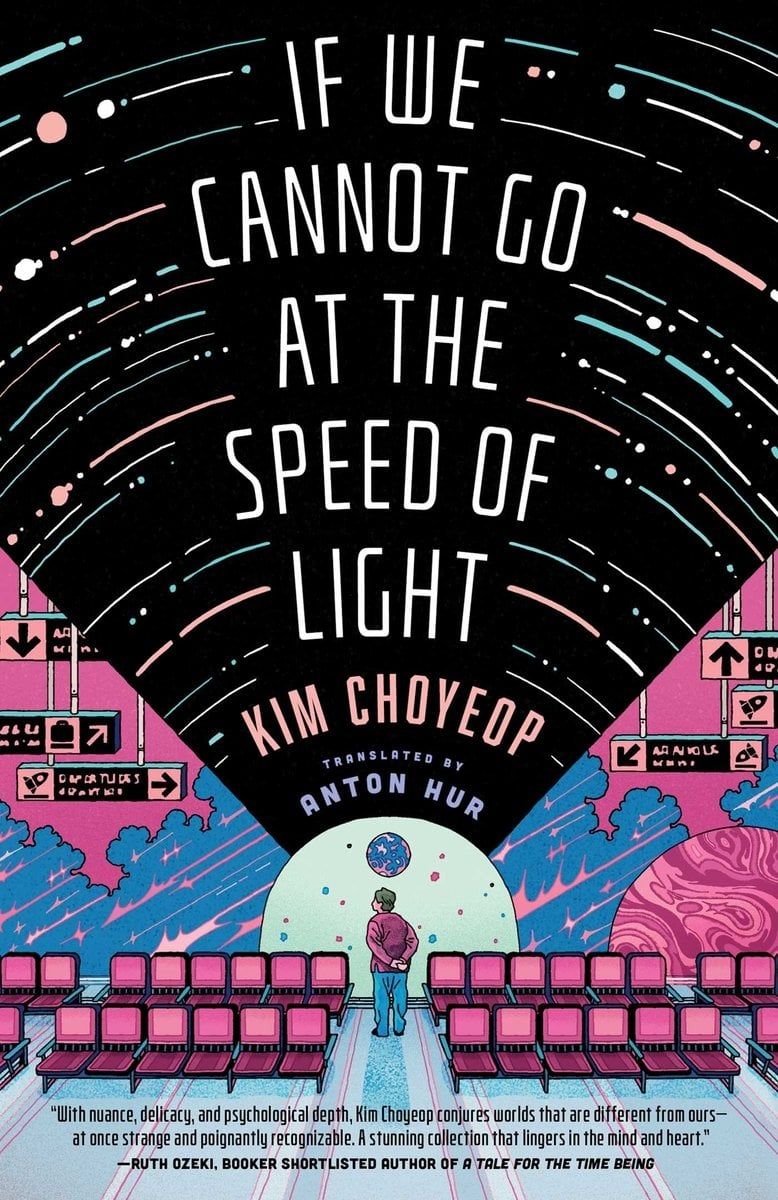
The book in question is If We Cannot Go at the Speed of Light, which is a collection of science fiction short stories by an apparently world-famous South Korean author named Kim Choyeop and translated by Anton Hur. Historically I’m a much bigger fan of the idea of short story collections than I am of the actual short story collections themselves. Typically if I enjoy a single story out of a collection I consider that a decent collection, but I can say this collection easily passes that bar. Of the seven stories, there was really only one that I didn’t care for at all, and all the rest I thought were pretty good to even great. While I wouldn’t dispute that the stories fall under the science fiction banner, I wouldn’t call Choyeop’s writing anything like hard sci-fi or even cyberpunk. Her style and approach are very much more grounded and would even be more along the lines of speculative fiction in a lot of cases.
The first of the short stories in the collection was by far my favorite by virtue of the big swing it takes as its premise. “Symbiosis Theory” opens with a short passage about Ludmilla Markov, who was a world-famous artist whose work consisted of art drawn from memories of places she’d never been to before. We then cut to the Institute for Neurointerpretation where scientists, through a set of experiments, have made a startling discovery about human development. They have found that as babies and up through around age seven, all humans have a mental symbiont that is an alien consciousness that they dub the “Them”. They further find that it’s that alien component that is vital for teaching humans such concepts as morality, ethics and altruism, the very foundation of humanity. The presence of the symbiont then disappears around the time that humans typically start to develop strong personal memories of self. The scientists struggle with whether or not they should even release these findings to the world, but they eventually realize that the fantastical art and world that Ludmilla had described in her works were actually the real memories of the homeworld of the aliens themselves. The story ends with the understanding that, out of all of humanity, she was the only person who had ever been able to sense them directly and was able to get them to not leave her consciousness as she aged, thus she never had to feel alone. A very touching and poignant end to such a high-concept story idea.
The other story I really enjoyed was “Spectrum”. The narrator retells the story of their grandmother, who was a deep-space explorer who had been missing for over 40 years. During her lost time, she crash-landed on an alien world where she was befriended by some of the intelligent life there, most particularly an individual by the name of “Louey”. While they were never able to communicate directly with one another, Louey became her protector and they lived for some time together on the alien world. Eventually the narrator’s grandmother (named Heejin) discovered that the aliens are very short-lived, only three to five years on average. But what she also learned is that they seem to maintain some continuity of self through a set of written papers that they store and maintain. They were sets of papers that, after many years, Heejin was finally able to look at, but was never able to fully understand because much of it was written in colors that human visual systems weren’t able to interpret. In the end, the fifth and final Louey she knew was killed in an animal attack, and she was able to find her crashed ship and eventually escape. Heejin then spent another decade alone in space before finally signaling for help in order to hide the location of the alien planet from humans. She knew that while on her own she was welcomed as a friend, the next time humanity would encounter that race, they would do so from a position of power and it probably would not end well for them sadly.
If you are looking for a quick sci-fi read, I think this is a good choice for you. The entire book clocks in around 186 pages, and each individual story rarely gets above 30 or 40 pages, so it’s easy to dip in and out of as you have the time. Based on my experience with the 2026 Booker shortlist, I absolutely don’t think this book will make it due to its actually being relatively upbeat and positive, but maybe positivity can reign over the translated works version this coming year.
This review contains affiliate links. If you buy through one I earn a small commission, at no extra cost to you.
- ← Previous
Excession